Halo Solutions is proud to be supporting a pioneering PhD research project at the University of Northampton focused on improving decision-making standards in live event environments.
The ongoing research, led by doctoral researcher Claire Drakeley, looks to explore how on-event decisions — often made under pressure and scrutiny — can be strengthened through clearer frameworks, structured thinking and applied learning. The research addresses one of the most critical challenges facing event professionals today:
How can on-event decision making be improved?
Bringing Real-World Systems into Academic Research
The 3-year partnership between Halo and the University brings collaborative development of student learning experiences and research activity linked to events and venue management.
As part of this collaboration, Halo is providing a dedicated, ring-fenced version of the Halo Incident Management System for use within the University’s simulation exercises, alongside hands-on system training for participating students. This ensures students not only learn how to use industry standard software, but understand how structured incident management and data capture supports effective decision-making in high-pressure environments.
Halo is also supporting the design and delivery of the live simulations, advising on how professional event control rooms operate in practice — from incident logging and escalation to task allocation and maintaining clear audit trails.
Rather than engaging solely with theory, students are working directly with the same type of operational tools and workflows used by security and event management teams across the industry.
“Decision-making in live event operations can be a bit of a dark art, caught between creating extraordinary experiences and keeping everyone safe, in a high pressure context with significant consequences. Not only that, but this process hasn’t been researched previously so the study, simulation and use of Halo are all part of enabling us to make better decisions, preventing escalation of issues into crises.”
– Claire Drakeley, Senior Lecturer and Programme Lead
Supporting Operation Nexus+
A key component of the collaboration is Operation Nexus+, a large-scale simulation exercise based on Silverstone Circuit; one of Halo’s most renowned motorsport partners.
The project brings together students from Events, Hospitality, Marketing, Criminal Justice, Policing and Tourism to simulate the coordination of a major live public event.
Within the exercise:
- Events students operate a simulated Event Control using radio communications, staff networks and Halo
- Other disciplines manage media response, investigations, guest impact and stakeholder liaison
- Participants respond in real time to evolving incidents and operational pressures
Halo’s system underpins the control room element of the exercise — enabling incident logging, task allocation, escalation tracking and decision recording in a way that mirrors real-world practice.
By basing elements of the simulation on one of Halo’s live customer environments (adapted for academic use), students gain exposure to authentic operational workflows while remaining within a safe, structured learning space.
Investing in the Future of the Industry
For Halo Solutions, this partnership reflects a broader commitment to supporting the long-term resilience and professionalism of the events sector.
Live events are complex, high-stakes environments and decisions made in moments of pressure can carry significant safety, reputational and financial implications. Supporting research that seeks to strengthen how those decisions are understood and applied is something we believe benefits the entire industry.
“If we want safer, more resilient events in the future, we need to invest in the people who will be leading them. Supporting applied research and realistic simulation is one of the most meaningful ways we can contribute to that goal.”
– Lloyd Major, CEO & Founder of Halo Solutions
Looking Ahead
Halo Solutions believes that meaningful industry progress happens when technology providers, academics, legislators and practitioners work together.
By supporting this research and embedding real-world incident management practice into higher education simulations, we are proud to play a small part in shaping a more prepared, more confident and more capable next generation of event professionals.
Because better preparation today leads to better decisions tomorrow.
Halo Solutions is pleased to announce a new collaboration with Showstop® Procedure , an award winning internationally accredited certification programme from the Pink Bows Foundation which is supported by global industry bodies and experts.
The inaugural course was launched in Houston, Texas in 2025, as an immersive, certificated one-day accredited programme for event professionals responsible for safety and event-day decision-making at concerts, festivals, stadia and large-scale public gatherings.
It equips planners, venue managers, safety leads and tactical decision-makers with structured frameworks, defined competencies and the confidence to plan, prepare for and execute a rapid, coordinated response when life-safety risks arise during live events, reducing the risk of system failure and enhancing command, control, coordination and communication during an emergency incident.
Halo has worked with Pink Bows Foundation to develop training-aligned material, namely a scenario-based video that demonstrates how a Showstop incident can be recorded, escalated and managed through the Halo System, an Incident Management system that supports real-time control room decision-making and post-event reporting.
The Showstop® Procedure course: A new standard for event safety
The Showstop® Procedure course was developed by internationally recognised crowd safety experts Steve Allen and Dr Mark Hamilton, who pioneered and named the Showstop® Procedure in the 1990s. Retained by the Pink Bows Foundation, they bring decades of frontline experience in event risk reduction, operational safety and crowd management, and have served as Expert Witnesses in multiple high-profile cases.
The course is internationally accredited by Highfield and the CPD Certification Service and is recognised across global safety networks for its professional credibility and practical application.
The training focuses on real-world readiness: it introduces a structured emergency intervention protocol that gives event leadership the tools to respond proportionately to emerging life-safety hazards, coordinate a tactical response and where necessary, implement Showstop® to regain control and restart if safe to do so within a structured framework.
This approach reflects industry leaders’ recognition that formal decision frameworks, supported by practice and systems integration, are integral to safer event outcomes. Showstop® is designed to help unify audience safety practice across jurisdictions and event types.
Supporting a Global Standard for Showstop Procedure
The Showstop® Procedure training programme is championed by the Pink Bows Foundation, a nonprofit founded by the Dubiski family following the tragic loss of their daughter Madison at the 2021 Astroworld Festival where 10 people died and hundreds of others were injured.
Pink Bows’ mission is to work collaboratively with the live-events industry to raise safety standards and help prevent similar tragedies in the future. The foundation has the support of major global crowd safety organisations, including the Event Safety Alliance (North America), Event Safety Alliance Canada, the Global Crowd Management Alliance and the United Kingdom Crowd Management Association, as well as endorsement from Sir Paul McCartney and seasoned safety professionals.
This collaborative effort marks one of the first attempts to standardise a global crowd safety procedure with third-party accreditation, training individuals not only in tactical implementation but also in the theory, planning and risk assessment that underpin event safety-critical decisions.
Bringing Training to Operational Reality
While the Showstop® course focuses on event personnel with safety-critical roles, the practical challenge for many organisations lies in operational execution, how control rooms, incident coordination teams and cross-functional staff apply these principles when incidents occur.
Halo’s contribution: a Showstop Procedure-aligned incident simulation video — helps to bridge that gap by showing how the Halo System can support Showstop Protocol and C4 framework with:
- Rapid incident capture when a safety threshold or trigger is recognised
- Delegated tasks and communication channels between safety, security, production and event control
- Audit-ready timelines and evidence trail’s to support post-event analysis and compliance
- Decision logs that help teams reflect on critical choices and outcomes
By aligning procedural training with practical implementation tooling, Halo and Pink Bows Foundation aim to help organisations move beyond theory into repeatable, defensible operations.
A Step Forward for Event Safety
As live events continue to attract large, diverse audiences, and as scrutiny on safety outcomes grows, coordinated training and integrated management systems are becoming essential components of risk mitigation.
The Showstop® Procedure course and associated materials reflect a broader industry shift toward tangible, accredited emergency frameworks; integrated decision support and management platforms; cross-discipline preparation spanning safety, production and operations; and universal understanding of risk thresholds and escalations.
Halo Solutions is proud to support this important initiative and looks forward to continuing partnerships that help translate crowd safety best practice into real-world operations.
Find out more about Showstop Procedure courses here
About Halo Solutions
Halo Solutions are on a mission to transform how technology is used to protect people. The Halo System is an all-in-one incident and risk management platform designed to give control rooms, security teams and safety leaders the tools they need to protect people and places more effectively. From planning and proactive risk management, through to live incident response, task coordination and post-event reporting, Halo brings every part of safety operations together in one place and records it all.
Introducing New Single Sign-On (SSO) for The Halo System.
Enterprise-grade access control. Seamless user experience. Stronger compliance by design.
Single Sign-On (SSO) is now available for all Halo System users — built in direct response to customer demand and designed to align with modern security and IT governance standards.
For organisations using Microsoft Entra ID, SSO enables secure, centralised authentication into Halo — removing password risk while strengthening control over user access.
Why SSO Matters for Security Leaders
Security isn’t just about incident response — it’s about identity control.
With SSO enabled, Halo users benefit from:
Centralised User Management
User provisioning, suspension and deletion are managed directly through your organisation’s Microsoft Entra tenant. No duplicated processes. No manual user clean-up. No forgotten accounts.
And when a user leaves your organisation, access to Halo is automatically revoked in line with your identity policies.
Enhanced Security & Compliance
SSO delegates authentication to your secure corporate environment.
- Enforced MFA (Multi-Factor Authentication)
- Conditional access policies
- Centralised password governance
- Audit consistency across applications
This ensures Halo aligns with your wider IT security architecture — not outside it.
Reduced Credential Risk
No additional Halo passwords to manage. Users authenticate through your organisation’s trusted identity provider, significantly reducing:
- Password reuse risk
- Credential sharing
- Weak password exposure
Seamless User Experience
Users log in with their corporate email address via your Microsoft environment. The experience is consistent across:
- Web access
- Mobile app login
- Multi-client environments
For large organisations operating multiple Halo accounts, a single Entra identity can securely access multiple Halo clients where configured.
Built for Real-World Operational Environments
We understand the complexity of control rooms, venues, transport hubs and critical infrastructure environments.
SSO has been designed to support:
- Existing Halo customers transitioning without losing permissions
- Multi-account organisations requiring cross-client access
- Controlled onboarding of new users
- Flexible support for temporary non-SSO users where operationally required
Halo Admins retain visibility and control over configuration — while identity authority remains with your IT team.
What Changes When You Enable SSO?
When SSO is activated:
- User creation, suspension and deletion are managed via Microsoft Entra
- Email addresses become the primary identifier
- Login transitions from username/password to secure identity provider authentication
- Sync occurs automatically (approx. 40-minute interval)
Your Partnerships Manager will support your onboarding to ensure a smooth transition.
Designed By You, Built By Us.
SSO was one of the most requested enterprise features from our customer base.
So we built it.
Not as a bolt-on workaround — but as a secure, properly integrated identity model aligned to modern security best practice.
Ready to Enable SSO?
Strengthen your access control.
Align Halo with your enterprise identity framework.
Reduce credential risk across your organisation.
Speak to your Partnerships Manager today to discuss activating SSO.
SSO FAQs
SSO for the Halo System currently supports integration with Microsoft Entra.
We’ve prioritised Entra due to its widespread adoption across enterprise, public sector and critical infrastructure organisations. We are looking to support other Identity Providers (IdPs) soon.
For existing clients, Halo intelligently matches users by email address to prevent duplication.
– Existing permissions are retained
– Users will log in using their corporate email address
– Authentication is delegated to your Microsoft Entra environment.
Your Partnerships Manager will guide you through transition planning and internal communications to ensure a smooth rollout.
Yes — where operationally required, non-SSO users can still be created by a Halo Admin.
However, for full compliance and identity governance benefits, we recommend managing the majority of users through your SSO connection. Your team can decide the right balance based on operational needs (for example, short-term contractors or event staff).
Yes — SSO is available at £1,250 per year per Halo client (unlimited users).
We’ve taken a transparent approach to pricing this feature. While SSO delivers significant security and compliance value to customers, it also required substantial backend redevelopment, security architecture changes, mobile login updates, and ongoing maintenance to ensure stability and secure synchronisation.
Rather than increasing core licence costs for all customers, we’ve chosen to make SSO an optional enhancement for organisations that require enterprise identity integration.
This allows us to:
– Continue investing in secure infrastructure
– Maintain and support the integration long-term
– Keep our standard Halo pricing competitive for customers who do not require SSO
If SSO aligns with your organisation’s security strategy, your Partnerships Manager can discuss activation and onboarding.
Halo Admins control the SSO configuration within Halo, but user lifecycle management (create, suspend, delete) moves to your Microsoft Entra environment once SSO is enabled.
This ensures:
– Centralised identity governance
– Consistent enforcement of MFA and conditional access
– Automatic removal of access when users leave your organisation
The result is stronger security alignment between Halo and your wider IT architecture.
Your Partnerships Manager will assist you with set-up, and we have a handy guide in our Halo Academy here.
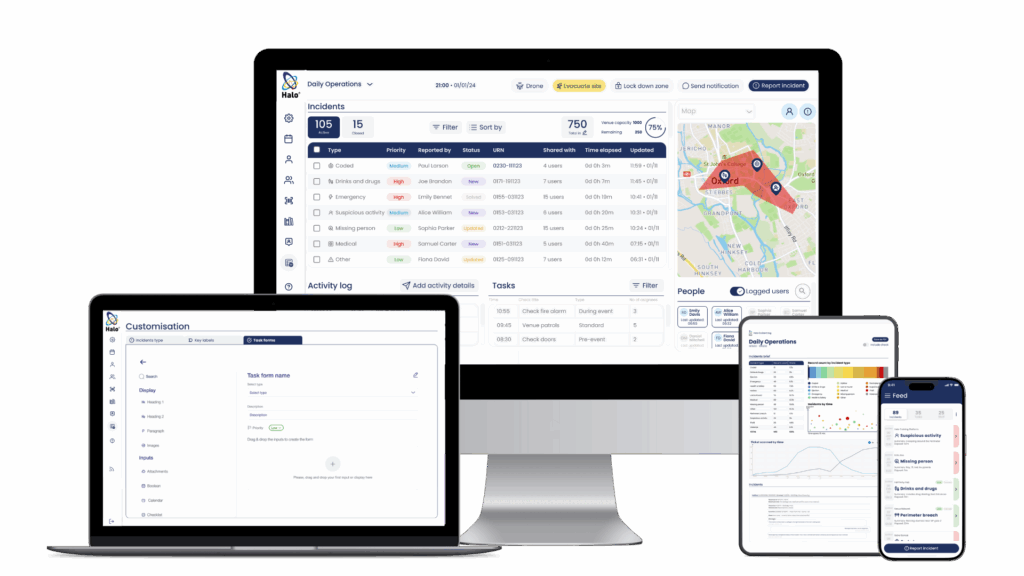
Ready to try it for yourself?
Book a demo and discover how The Halo System can help you achieve safety & security excellence.
Christmas markets are now a fixture of the UK’s winter economy. A valuable boost for local businesses, a driver of tourism, and a key seasonal attraction for councils and communities. But they are also complex operations with dense footfall, temporary structures, winter weather challenges, and diverse stakeholder roles. Ensuring they run safely and efficiently requires more than goodwill and fairy lights. It demands structured planning, strong communication, and a coordinated operational approach.
To the public, Christmas markets feel spontaneous and organic. To operators, they are anything but. The challenges are predictable but complex:
- Crowds that swell and contract unpredictably
- Narrow walkways prone to bottlenecks
- Stalls with cooking equipment, electrics and storage in tight spaces
- Wet and icy conditions that silently multiply slip risks
- Trader compliance requirements spanning fire, food safety, waste and more
- Visitors ranging from families with prams to late-evening drinkers
- Public spaces not designed for sustained event-level activity
None of these issues are new to event planners, local councils or security providers involved in Christmas markets, but the way they combine creates a uniquely demanding operating environment.
And unlike stadiums, music festivals or other large-scale events, there’s no universally adopted, sector-wide standard for managing Christmas markets specifically. The risks are well understood, the stakeholders are experienced, and the public expectations are consistent, yet every market evolves in its own way. Layouts differ, local policies vary, infrastructure changes year to year, and markets expand, contract or relocate based on opportunity and budget.
So how can we ensure our safety & security operations keep up?
Security That’s Effective, Not Heavy-Handed
Security at Christmas markets has matured significantly in recent years. Most professionals in this space already understand the fundamentals: visible reassurance, good communication and proportionate measures. What’s evolving now, and where real value lies, is in how security integrates with the overall operational picture.
Rather than treating security as a standalone function, the most effective markets take an approach where security, safety, welfare and crowd management operate as one intelligence network. That’s where subtle innovations make a difference:
- Behavioural insight shared in real time across operational teams (rather than siloed in security channels) ensures early indicators of issues, from crowd surges to welfare concerns, are acted on collectively rather than sequentially.
- Security presence mapped to crowd patterns, not fixed positions allows resource deployment to shift proactively as footfall changes throughout the day. This turns static guarding into dynamic, data-informed positioning.
- Vendor-facing communication improves situational awareness. Vendors often spot emerging issues first, long before they reach a radio. Treating them as part of the safety network through public reporting creates early-warning capability that security teams alone can’t replicate.
- Integrated customer-service training for stewards and security strengthens de-escalation and public confidence. A well-handled minor incident prevents the major one that never needs to occur.
- Subtle environmental cues such as lighting, layout, sound levels and the positioning of staff play a far greater role in shaping visitor behaviour than overt enforcement. Strategic design becomes part of the security strategy.
- Information consistency is often the biggest differentiator: When security, operations and local authorities work from the same real-time information, response time drops drastically and actions remain coherent under pressure.
This integrated, intelligence-led model ensures security isn’t just effective — it’s a seamless part of the public experience. Visitors perceive the market as well run, well supported, and confidently managed, without ever feeling like the environment is being controlled for them.
The aim isn’t to introduce more security, but to connect it more intelligently with the rest of the operation.
Adopting a Control-Room Mindset (Even Without an Actual Control Room)
One of the most impactful upgrades any Christmas market can make is adopting a control-room mindset. This doesn’t require expensive infrastructure or a permanently staffed operations hub. It simply means borrowing the principles that make well-run control environments so effective:
- Shared situational awareness
- Clear, unified communication channels
- Consistent, centralised incident logging
- Defined responsibilities and escalation pathways
- A common operating picture for all agencies and stakeholders
- Real-time decision-making supported by the right information
Most Christmas markets involve multiple organisations — councils, operators, security teams, first aid, traders, volunteers. Without coordinated communication, information gets trapped in silos, duplicated across radios, or lost entirely. With a control-room mindset, every team member becomes part of a connected operational network.
This approach reduces friction, improves response times, and gives organisers the ability to catch small issues early before they escalate into bigger ones that threaten safety or disrupt the visitor experience.
Capturing Intelligence That Actually Makes a Difference
Christmas markets run for multiple days or weeks, which creates a valuable opportunity: continuous improvement in real time.
Capturing accurate data like incidents, near misses, crowd trends, weather impacts, vendor issues, public enquiries, welfare needs and more allows organisers to:
- Adjust staffing to match peak flow
- Reconfigure problematic walkways
- Reposition or support specific vendors
- Anticipate recurring issues
- Evidence compliance and due diligence
- Improve planning for future years
A market that learns every day performs better every day. Intelligence doesn’t need to be complex; it simply needs to be consistent. Structured reporting and un-tamperable, easily retrievable logs create a feedback loop that elevates safety, efficiency and visitor satisfaction.
Connected Operations = Seamless Seasonal Experiences
Christmas markets succeed when all the moving parts operate as a connected system rather than parallel teams. The risks are familiar, the expertise already exists, and the commitment from organisers is consistently high. What often makes the difference is how well information flows, how consistently incidents are logged, and how easily teams can build a shared understanding of what’s happening across the site.
By adopting an intelligence-led, connected approach, Christmas markets become safer, smoother and easier to run not through more resource, but through better coordination and clearer communication. When everyone sees the same information at the same time, decision-making sharpens, responses become faster, and the entire operation feels more coherent to both staff and visitors.
For teams looking to strengthen that level of coordination — whether for Christmas markets or any other public event — Halo provides a platform designed specifically to support multi-agency collaboration and real-time operational clarity. You can learn more about how we support event, local authority and security partners at www.halosolutions.com.
After decades of campaigning, the Public Office (Accountability) Bill, known as the Hillsborough Law, has been introduced into parliament to enshrine accountability and honesty at the heart of public service. It marks a seismic shift in how organisations are expected to behave before and after major incidents. But what does this actually mean for stadium safety teams? What are the operational implications, and what steps should be taken to help embed a culture of transparency and accountability across the industry?
Embedding Candour and Compliance at the Centre of Operations
Any legislation that strengthens public safety and accountability is a positive and necessary step. No family should have to face misinformation or blame in the aftermath of losing a loved one. That’s why the introduction of the Hillsborough Law is being so well received; it reinforces the moral and legal expectation that truth and transparency must underpin all responses to major incidents.
Under this new legislation, stadiums and events companies across Britain are now reviewing their safety procedures and reporting standards. In industries like aviation, strict safeguards, compliance, governance and legislation have been of huge benefit to public safety. The expectation is that the events sector will see the same benefits by introducing processes to improve and centralise record keeping.
Systems that capture activity and provide time-stamped evidence of everything that has taken place will allow operators to provide complete transparency around what was done and when in the event of an incident. This gives confidence and credibility for those in positions of accountability that must act as spokespersons, while meeting insurers’ demands and providing reassurances to the public.
Practical Steps for Event Operators
For event operators looking to evolve and ensure they comply with the Hillsborough Law, a useful starting point is to ask: can you find out what is happening across your site, right now, on one dashboard? Can you trust its accuracy and, most importantly, can you prove its accuracy? If the answer is no, then your business has structural and procedural weaknesses that can be addressed through better communication, clearer data management, and stronger leadership commitment to transparency.
Embedding digital record-keeping, timestamped evidence, and data integrity into everyday practice ensures that safety and accountability are not afterthoughts but integral parts of operations. Leadership commitment is critical. Senior teams must model the standards they expect others to follow.
Ultimately, organisations should avoid reactive, box-ticking approaches to new legislation and instead focus on building a sustainable culture of safety excellence. This proactive approach will naturally align with the spirit and requirements of emerging legal frameworks like the Hillsborough Law.
Technology is the Backbone of Transparency
Digital systems play a crucial role in supporting compliance and transparency. When safety processes are documented in real time and stored in a central, auditable format, they become easier to analyse, review and learn from. Such systems eliminate duplication, improve efficiency and help establish a single, verifiable source of truth. The data these systems generate can also identify trends, inform training, and enhance proactive risk management –- creating a culture where accountability and safety are embedded in everyday operations.
Conclusion
For too long, families have had to fight simply for honesty and accountability in the wake of tragedy. The new duty of candour recognises what so many in the industry already know: that truth and transparency save lives, protect reputations, and rebuild trust. But candour can’t exist without evidence.
Clear, time-stamped records and accountable systems and processes are what allow organisations to show not just what decisions were made, but why. That’s how lessons are learned and how confidence is restored. Now is the time for the industry to go further and adopt a holistic approach to safety operations, where nothing is left to memory or chance, and accountability is built in from the very start.
Halo Solutions is delighted to welcome Emirates Old Trafford, home of Lancashire Cricket, to the Halo Community, joining a network of world-leading venues using the Halo System to enhance safety, communication, and operational efficiency.
A world-class sporting and entertainment destination with over 450,000 visitors a year, Emirates Old Trafford hosts international cricket, major concerts, and large-scale events all year round. With tens of thousands of guests visiting the venue annually, maintaining exceptional standards of safety and experience is paramount.
By implementing The Halo System, Emirates Old Trafford’s teams will gain a unified digital platform for:
- Real-time incident management: ensuring faster response times and improved situational awareness
- Integrated task management: enabling departments to coordinate seamlessly before, during, and after events
- Data-led insights: helping management teams review performance, identify trends, and continuously improve operations
This partnership reinforces both organisations’ shared commitment to innovation, collaboration, and public safety.
“Emirates Old Trafford is an iconic venue, and we’re proud to support Lancashire Cricket in their mission to deliver safe, efficient, and world-class experiences,” said Charlie Archer, Head of Partnerships Success at Halo Solutions. “It’s fantastic to see another major sporting venue embrace digital transformation to protect people and enhance operations.”
Halo Solutions continues to expand its footprint across the UK’s sporting, entertainment, and major events landscape helping venues and organisers deliver safer, smarter, and more connected experiences for all.

Infologue.com: Why Every Venue Needs Its Own ‘Black Box’ for Public Safety
The UK’s longest running online security magazine explores the messaging behind Halo’s recent ‘Black Box’ campaign, which examines how UK venues are still relying on fragmented incident data, manual logs, and radios to manage risk. As legislation tightens and expectations rise, the case is clear: operators need a unified, tamper-proof “black box” equivalent for public safety.
“In aviation, a black box is indispensable. It records every detail—conversations, data, timings, and decisions—offering the only reliable way to learn from an incident. Without one, a flight would never leave the ground.
Yet across the UK, thousands of venues—from stadiums and transport hubs to shopping centers and campuses—operate daily without their equivalent of a black box.
When incidents occur, operators often rely on fragmented data scattered across spreadsheets, emails, WhatsApp groups and radio logs. The lack of a centralized, tamper-proof record makes it difficult to reconstruct what happened or demonstrate accountability.
Lloyd Major, CEO of Halo Solutions, believes this must change. ‘A digital black box for venues is becoming both a moral and operational necessity,’ he said.“
Read the full article here.
When protest activity occurs at your venue, clear communication is critical. It allows you to support peaceful protestors while managing individuals who may pose a threat. Effective protest management involves not only your internal team but also coordination with emergency services and third parties.
Ensuring that everyone involved from security teams, to venue staff, to emergency services uses common terminology and protest management tactics can make a significant difference to both safety and compliance.
Below, we break down essential terminology, legal considerations, designated protest sites, and leadership roles to help your venue prepare.
The Spectrum of Protest
Protests are not one-size-fits-all. Understanding the spectrum of protestors helps you respond appropriately:
- Supporters
Supporters are individuals who advocate for a cause in everyday life. They may wear badges or t-shirts, host fundraisers, or display posters. Supporters are generally peaceful and not involved in direct protest activity. - Protestors
Protestors are the visible crowd who assemble to express disagreement with an action or decision. Most protestors are peaceful, compliant, and easy to engage with. - Activists
Activists are willing to commit crimes to amplify their message or disrupt business operations. Their actions are targeted but may cross legal boundaries. - Extremists
Extremists act without concern for safety or legal consequences, potentially causing life-altering injury or death.
Identifying the 0.01%: Evidence shows that roughly 10% of protest crowds may be activists, and 10% of those activists may be extremists. Identifying this small group helps emergency services apply legitimate policing without disrupting peaceful protestors.
Legal Obligations: Human Rights Act
While the Human Rights Act applies only to public authorities, following its spirit can foster positive engagement with protestors. Applying principles of fairness and respect can enhance your venue’s reputation and lead to constructive relationships for future events.
Designated Protest Sites
Although peaceful protest can occur anywhere, establishing designated protest sites on private land can simplify management. These sites, agreed upon with police, help you:
- Plan for crowd capacity
- Understand landowner liabilities
- Navigate relevant legislation
Working with authorities in advance ensures your venue remains compliant while enabling protestors to exercise their rights safely.
Leadership Roles for Managing Protests
Effective protest management relies on clear leadership. Allocating your team into strategic, tactical, and operational roles ensures information flows efficiently and decisions are made in the right order.
Regular exercises and pre-agreed responsibilities help your leadership team respond quickly, minimise risk, and maintain order during protest activity.
Want to Learn More?
Halo Solutions is already helping events, venues, transport hubs and more manage protests safely and effectively. Discover how a digital incident management system can support your safety & security operations here: How a digital incident management system helps you to support and manage successful protests
Or learn more about policing powers in this handy Pocket Legislation Guide for UK Venues & Events
Halo Solutions is delighted to announce a new partnership with ParcelTracker, the smart mailroom and parcel management platform trusted by thousands of institutions worldwide. ParcelTracker joins Halo’s Introducer Programme, enabling both organisations to share expertise, amplify each other’s offerings, and deliver even greater value to their customers.
About ParcelTracker
Founded in 2016, ParcelTracker is transforming the way organisations manage parcels and post. With more than 380,000 users across four continents, and customers ranging from Greystar to NASA, ParcelTracker’s cutting-edge software leverages advanced AI scanning to eliminate manual data entry, increase accuracy, and streamline operations in mailrooms, receptions, receiving bays, and corporate logistics teams.
Every week, over 100,000 parcels and mail items are scanned and tracked using ParcelTracker, helping universities, healthcare organisations, government departments, commercial high-rises, and venues save time, reduce losses, and improve resident and tenant experiences.
As leaders in the mailroom management and parcel management software space, Sustainability is at the heart of ParcelTracker’s mission. To date, the company has carbon offset more than 1 million deliveries and planted over 10,000 trees in partnership with the Eden Reforestation Project – making every scan count towards a greener future.
Why This Partnership Matters
The partnership between Halo Solutions and ParcelTracker is about creating mutual value for clients. As a Halo Introducer, ParcelTracker will connect its customers with Halo’s award-winning incident and event management platform, while Halo will spotlight ParcelTracker as a recommended partner for mailroom and logistics efficiency.
For customers, the benefit is expert-backed recommendations from trusted industry providers who understand the pressures of operating safe, efficient, and resilient organisations. Whether it’s protecting people or tracking parcels, Halo and ParcelTracker share a common ethos – simplifying complexity, driving accountability, and delivering long-term value.
“ParcelTracker is solving an operational challenge that many of our customers face. We’re proud to recommend them through our Introducer Programme and look forward to seeing how this collaboration benefits clients on both sides.” – Lois Warner, BDM @ Halo Solutions
A Collaborative Future
Through this partnership, both organisations will also work to amplify each other’s message, shining a light on the challenges, and the people, at the heart of public safety and operational resilience. Halo’s Introducer Programme and HaloMarketplace is designed to make it easier for customers to access best-in-class solutions, backed by trusted relationships and transparent service. ParcelTracker’s inclusion strengthens this ecosystem, expanding the options available to Halo’s clients without adding noise or complexity.
“We’re excited to join Halo’s Introducer Programme. Halo shares our values of transparency, trust, and delivering real results for customers, and together we can create even greater value for the organisations we support.” – Liam Hamill, Head of PBSA & HE @ ParcelTracker
Looking Ahead
This is just the start of Halo and ParcelTracker’s collaboration. Both organisations will continue to seek opportunities to connect customers with trusted, proven solutions, helping them operate more safely, efficiently, and sustainably.
Halo Solutions is excited to announce a new partnership with You. Smart. Thing. (YST), the travel demand management platform transforming the way people plan and experience journeys to events, venues, and destinations around the world.
Backed by Future Planet Capital, both Halo and YST are united by a shared commitment to innovation, sustainability, and customer-first technology. YST is growing exponentially have doubled its annual recurring revenue each year in the last 3 years, and is trusted by major clients such as London Marathon Events and Transport for Greater Manchester (TfGM), who process over 1.2 million journey plans a month through the platform.
About You. Smart. Thing.
You. Smart. Thing. provides a web-based travel planning application that can be seamlessly embedded into client systems and digital touchpoints. For every visitor, it creates a personalised travel plan, whether for a local council, major sporting event, or international venue, helping make people’s journey as smooth and sustainable as possible.
Unlike generic mapping tools, that aren’t localised or optimised for specific events, YST is built for complexity. The platform integrates road closures, special event services, and bespoke ingress and egress routes, ensuring visitors get the most accurate and up-to-date information. Each interaction generates valuable data for the client, from operational insights and safety planning to carbon reporting and new revenue opportunities.
Every client receives a white-labelled travel assistant, and can also send personalised travel plans directly to their own customers, boosting engagement and delivering a seamless visitor experience.
Why This Partnership Matters
Halo and YST serve many of the same sectors including stadia, venues, local authorities, transport and major events where large crowds, complex logistics, and public safety are critical. Together, the two companies are bringing complementary strengths to a shared challenge: managing how people arrive, move, and leave safely.
For Halo clients, YST offers new ways to encourage visitors to plan their travel in advance, shape arrival and departure flows, and avoid unnecessary crowding. Real-time travel insights can be factored into risk planning, ingress and egress management, and resource allocation, supporting safer operations and better visitor experiences.
For YST clients, Halo brings world-class incident management and safety planning expertise. By applying travel and crowd flow insights gained from YST, operations teams can anticipate and respond dynamically to changes through The Halo System, deploying staff to the right place, at the right time, and keeping visitors informed when incidents disrupt travel or access.
Both organisations are also closely aligned on sustainability. Halo helps clients reduce reliance on paper and manual processes, while YST empowers travellers to make low-carbon travel choices and supports client ESG reporting.
A Collaborative Approach
This partnership begins with mutual support and introductions between Halo and YST clients, with a view to future opportunities for deeper integration. Both companies see potential in combining their platforms to support real-time crowd movement and wayfinding at large events, enabling venues and organisers to decide not only how people get to their site, but how they navigate it once there.
“This partnership is about more than technology. Together with You. Smart. Thing. we can help venues and events deliver safer, smoother, and more sustainable visitor experiences—something our customers are increasingly aware of.” – Lloyd Major, CEO of Halo Solutions
“We’re proud to partner with Halo Solutions, whose values mirror our own. By combining our expertise in smart travel planning with Halo’s leadership in incident management and safety, we can support clients in achieving operational excellence and raising industry standards.” – Chris Thompson, CEO of You. Smart. Thing
Looking Ahead
Halo will feature You. Smart. Thing. in the upcoming HaloMarketplace launch this October, providing clients with trusted recommendations for technology and products for security and operations managers. Meanwhile, both companies will continue to champion each other in sectors where their combined offering delivers the greatest impact.
This partnership underscores Halo and YST’s shared mission: making travel safer, smarter, and more sustainable for visitors, operators, and the wider community.