After decades of campaigning, the Public Office (Accountability) Bill, known as the Hillsborough Law, has been introduced into parliament to enshrine accountability and honesty at the heart of public service. It marks a seismic shift in how organisations are expected to behave before and after major incidents. But what does this actually mean for stadium safety teams? What are the operational implications, and what steps should be taken to help embed a culture of transparency and accountability across the industry?
Embedding Candour and Compliance at the Centre of Operations
Any legislation that strengthens public safety and accountability is a positive and necessary step. No family should have to face misinformation or blame in the aftermath of losing a loved one. That’s why the introduction of the Hillsborough Law is being so well received; it reinforces the moral and legal expectation that truth and transparency must underpin all responses to major incidents.
Under this new legislation, stadiums and events companies across Britain are now reviewing their safety procedures and reporting standards. In industries like aviation, strict safeguards, compliance, governance and legislation have been of huge benefit to public safety. The expectation is that the events sector will see the same benefits by introducing processes to improve and centralise record keeping.
Systems that capture activity and provide time-stamped evidence of everything that has taken place will allow operators to provide complete transparency around what was done and when in the event of an incident. This gives confidence and credibility for those in positions of accountability that must act as spokespersons, while meeting insurers’ demands and providing reassurances to the public.
Practical Steps for Event Operators
For event operators looking to evolve and ensure they comply with the Hillsborough Law, a useful starting point is to ask: can you find out what is happening across your site, right now, on one dashboard? Can you trust its accuracy and, most importantly, can you prove its accuracy? If the answer is no, then your business has structural and procedural weaknesses that can be addressed through better communication, clearer data management, and stronger leadership commitment to transparency.
Embedding digital record-keeping, timestamped evidence, and data integrity into everyday practice ensures that safety and accountability are not afterthoughts but integral parts of operations. Leadership commitment is critical. Senior teams must model the standards they expect others to follow.
Ultimately, organisations should avoid reactive, box-ticking approaches to new legislation and instead focus on building a sustainable culture of safety excellence. This proactive approach will naturally align with the spirit and requirements of emerging legal frameworks like the Hillsborough Law.
Technology is the Backbone of Transparency
Digital systems play a crucial role in supporting compliance and transparency. When safety processes are documented in real time and stored in a central, auditable format, they become easier to analyse, review and learn from. Such systems eliminate duplication, improve efficiency and help establish a single, verifiable source of truth. The data these systems generate can also identify trends, inform training, and enhance proactive risk management –- creating a culture where accountability and safety are embedded in everyday operations.
Conclusion
For too long, families have had to fight simply for honesty and accountability in the wake of tragedy. The new duty of candour recognises what so many in the industry already know: that truth and transparency save lives, protect reputations, and rebuild trust. But candour can’t exist without evidence.
Clear, time-stamped records and accountable systems and processes are what allow organisations to show not just what decisions were made, but why. That’s how lessons are learned and how confidence is restored. Now is the time for the industry to go further and adopt a holistic approach to safety operations, where nothing is left to memory or chance, and accountability is built in from the very start.
Halo Solutions is delighted to welcome Emirates Old Trafford, home of Lancashire Cricket, to the Halo Community, joining a network of world-leading venues using the Halo System to enhance safety, communication, and operational efficiency.
A world-class sporting and entertainment destination with over 450,000 visitors a year, Emirates Old Trafford hosts international cricket, major concerts, and large-scale events all year round. With tens of thousands of guests visiting the venue annually, maintaining exceptional standards of safety and experience is paramount.
By implementing The Halo System, Emirates Old Trafford’s teams will gain a unified digital platform for:
- Real-time incident management: ensuring faster response times and improved situational awareness
- Integrated task management: enabling departments to coordinate seamlessly before, during, and after events
- Data-led insights: helping management teams review performance, identify trends, and continuously improve operations
This partnership reinforces both organisations’ shared commitment to innovation, collaboration, and public safety.
“Emirates Old Trafford is an iconic venue, and we’re proud to support Lancashire Cricket in their mission to deliver safe, efficient, and world-class experiences,” said Charlie Archer, Head of Partnerships Success at Halo Solutions. “It’s fantastic to see another major sporting venue embrace digital transformation to protect people and enhance operations.”
Halo Solutions continues to expand its footprint across the UK’s sporting, entertainment, and major events landscape helping venues and organisers deliver safer, smarter, and more connected experiences for all.

Infologue.com: Why Every Venue Needs Its Own ‘Black Box’ for Public Safety
The UK’s longest running online security magazine explores the messaging behind Halo’s recent ‘Black Box’ campaign, which examines how UK venues are still relying on fragmented incident data, manual logs, and radios to manage risk. As legislation tightens and expectations rise, the case is clear: operators need a unified, tamper-proof “black box” equivalent for public safety.
“In aviation, a black box is indispensable. It records every detail—conversations, data, timings, and decisions—offering the only reliable way to learn from an incident. Without one, a flight would never leave the ground.
Yet across the UK, thousands of venues—from stadiums and transport hubs to shopping centers and campuses—operate daily without their equivalent of a black box.
When incidents occur, operators often rely on fragmented data scattered across spreadsheets, emails, WhatsApp groups and radio logs. The lack of a centralized, tamper-proof record makes it difficult to reconstruct what happened or demonstrate accountability.
Lloyd Major, CEO of Halo Solutions, believes this must change. ‘A digital black box for venues is becoming both a moral and operational necessity,’ he said.“
Read the full article here.
When protest activity occurs at your venue, clear communication is critical. It allows you to support peaceful protestors while managing individuals who may pose a threat. Effective protest management involves not only your internal team but also coordination with emergency services and third parties.
Ensuring that everyone involved from security teams, to venue staff, to emergency services uses common terminology and protest management tactics can make a significant difference to both safety and compliance.
Below, we break down essential terminology, legal considerations, designated protest sites, and leadership roles to help your venue prepare.
The Spectrum of Protest
Protests are not one-size-fits-all. Understanding the spectrum of protestors helps you respond appropriately:
- Supporters
Supporters are individuals who advocate for a cause in everyday life. They may wear badges or t-shirts, host fundraisers, or display posters. Supporters are generally peaceful and not involved in direct protest activity. - Protestors
Protestors are the visible crowd who assemble to express disagreement with an action or decision. Most protestors are peaceful, compliant, and easy to engage with. - Activists
Activists are willing to commit crimes to amplify their message or disrupt business operations. Their actions are targeted but may cross legal boundaries. - Extremists
Extremists act without concern for safety or legal consequences, potentially causing life-altering injury or death.
Identifying the 0.01%: Evidence shows that roughly 10% of protest crowds may be activists, and 10% of those activists may be extremists. Identifying this small group helps emergency services apply legitimate policing without disrupting peaceful protestors.
Legal Obligations: Human Rights Act
While the Human Rights Act applies only to public authorities, following its spirit can foster positive engagement with protestors. Applying principles of fairness and respect can enhance your venue’s reputation and lead to constructive relationships for future events.
Designated Protest Sites
Although peaceful protest can occur anywhere, establishing designated protest sites on private land can simplify management. These sites, agreed upon with police, help you:
- Plan for crowd capacity
- Understand landowner liabilities
- Navigate relevant legislation
Working with authorities in advance ensures your venue remains compliant while enabling protestors to exercise their rights safely.
Leadership Roles for Managing Protests
Effective protest management relies on clear leadership. Allocating your team into strategic, tactical, and operational roles ensures information flows efficiently and decisions are made in the right order.
Regular exercises and pre-agreed responsibilities help your leadership team respond quickly, minimise risk, and maintain order during protest activity.
Want to Learn More?
Halo Solutions is already helping events, venues, transport hubs and more manage protests safely and effectively. Discover how a digital incident management system can support your safety & security operations here: How a digital incident management system helps you to support and manage successful protests
Or learn more about policing powers in this handy Pocket Legislation Guide for UK Venues & Events
Halo Solutions is delighted to announce a new partnership with ParcelTracker, the smart mailroom and parcel management platform trusted by thousands of institutions worldwide. ParcelTracker joins Halo’s Introducer Programme, enabling both organisations to share expertise, amplify each other’s offerings, and deliver even greater value to their customers.
About ParcelTracker
Founded in 2016, ParcelTracker is transforming the way organisations manage parcels and post. With more than 380,000 users across four continents, and customers ranging from Greystar to NASA, ParcelTracker’s cutting-edge software leverages advanced AI scanning to eliminate manual data entry, increase accuracy, and streamline operations in mailrooms, receptions, receiving bays, and corporate logistics teams.
Every week, over 100,000 parcels and mail items are scanned and tracked using ParcelTracker, helping universities, healthcare organisations, government departments, commercial high-rises, and venues save time, reduce losses, and improve resident and tenant experiences.
As leaders in the mailroom management and parcel management software space, Sustainability is at the heart of ParcelTracker’s mission. To date, the company has carbon offset more than 1 million deliveries and planted over 10,000 trees in partnership with the Eden Reforestation Project – making every scan count towards a greener future.
Why This Partnership Matters
The partnership between Halo Solutions and ParcelTracker is about creating mutual value for clients. As a Halo Introducer, ParcelTracker will connect its customers with Halo’s award-winning incident and event management platform, while Halo will spotlight ParcelTracker as a recommended partner for mailroom and logistics efficiency.
For customers, the benefit is expert-backed recommendations from trusted industry providers who understand the pressures of operating safe, efficient, and resilient organisations. Whether it’s protecting people or tracking parcels, Halo and ParcelTracker share a common ethos – simplifying complexity, driving accountability, and delivering long-term value.
“ParcelTracker is solving an operational challenge that many of our customers face. We’re proud to recommend them through our Introducer Programme and look forward to seeing how this collaboration benefits clients on both sides.” – Lois Warner, BDM @ Halo Solutions
A Collaborative Future
Through this partnership, both organisations will also work to amplify each other’s message, shining a light on the challenges, and the people, at the heart of public safety and operational resilience. Halo’s Introducer Programme and HaloMarketplace is designed to make it easier for customers to access best-in-class solutions, backed by trusted relationships and transparent service. ParcelTracker’s inclusion strengthens this ecosystem, expanding the options available to Halo’s clients without adding noise or complexity.
“We’re excited to join Halo’s Introducer Programme. Halo shares our values of transparency, trust, and delivering real results for customers, and together we can create even greater value for the organisations we support.” – Liam Hamill, Head of PBSA & HE @ ParcelTracker
Looking Ahead
This is just the start of Halo and ParcelTracker’s collaboration. Both organisations will continue to seek opportunities to connect customers with trusted, proven solutions, helping them operate more safely, efficiently, and sustainably.
Halo Solutions is excited to announce a new partnership with You. Smart. Thing. (YST), the travel demand management platform transforming the way people plan and experience journeys to events, venues, and destinations around the world.
Backed by Future Planet Capital, both Halo and YST are united by a shared commitment to innovation, sustainability, and customer-first technology. YST is growing exponentially have doubled its annual recurring revenue each year in the last 3 years, and is trusted by major clients such as London Marathon Events and Transport for Greater Manchester (TfGM), who process over 1.2 million journey plans a month through the platform.
About You. Smart. Thing.
You. Smart. Thing. provides a web-based travel planning application that can be seamlessly embedded into client systems and digital touchpoints. For every visitor, it creates a personalised travel plan, whether for a local council, major sporting event, or international venue, helping make people’s journey as smooth and sustainable as possible.
Unlike generic mapping tools, that aren’t localised or optimised for specific events, YST is built for complexity. The platform integrates road closures, special event services, and bespoke ingress and egress routes, ensuring visitors get the most accurate and up-to-date information. Each interaction generates valuable data for the client, from operational insights and safety planning to carbon reporting and new revenue opportunities.
Every client receives a white-labelled travel assistant, and can also send personalised travel plans directly to their own customers, boosting engagement and delivering a seamless visitor experience.
Why This Partnership Matters
Halo and YST serve many of the same sectors including stadia, venues, local authorities, transport and major events where large crowds, complex logistics, and public safety are critical. Together, the two companies are bringing complementary strengths to a shared challenge: managing how people arrive, move, and leave safely.
For Halo clients, YST offers new ways to encourage visitors to plan their travel in advance, shape arrival and departure flows, and avoid unnecessary crowding. Real-time travel insights can be factored into risk planning, ingress and egress management, and resource allocation, supporting safer operations and better visitor experiences.
For YST clients, Halo brings world-class incident management and safety planning expertise. By applying travel and crowd flow insights gained from YST, operations teams can anticipate and respond dynamically to changes through The Halo System, deploying staff to the right place, at the right time, and keeping visitors informed when incidents disrupt travel or access.
Both organisations are also closely aligned on sustainability. Halo helps clients reduce reliance on paper and manual processes, while YST empowers travellers to make low-carbon travel choices and supports client ESG reporting.
A Collaborative Approach
This partnership begins with mutual support and introductions between Halo and YST clients, with a view to future opportunities for deeper integration. Both companies see potential in combining their platforms to support real-time crowd movement and wayfinding at large events, enabling venues and organisers to decide not only how people get to their site, but how they navigate it once there.
“This partnership is about more than technology. Together with You. Smart. Thing. we can help venues and events deliver safer, smoother, and more sustainable visitor experiences—something our customers are increasingly aware of.” – Lloyd Major, CEO of Halo Solutions
“We’re proud to partner with Halo Solutions, whose values mirror our own. By combining our expertise in smart travel planning with Halo’s leadership in incident management and safety, we can support clients in achieving operational excellence and raising industry standards.” – Chris Thompson, CEO of You. Smart. Thing
Looking Ahead
Halo will feature You. Smart. Thing. in the upcoming HaloMarketplace launch this October, providing clients with trusted recommendations for technology and products for security and operations managers. Meanwhile, both companies will continue to champion each other in sectors where their combined offering delivers the greatest impact.
This partnership underscores Halo and YST’s shared mission: making travel safer, smarter, and more sustainable for visitors, operators, and the wider community.
What is the Incident Response Curve?
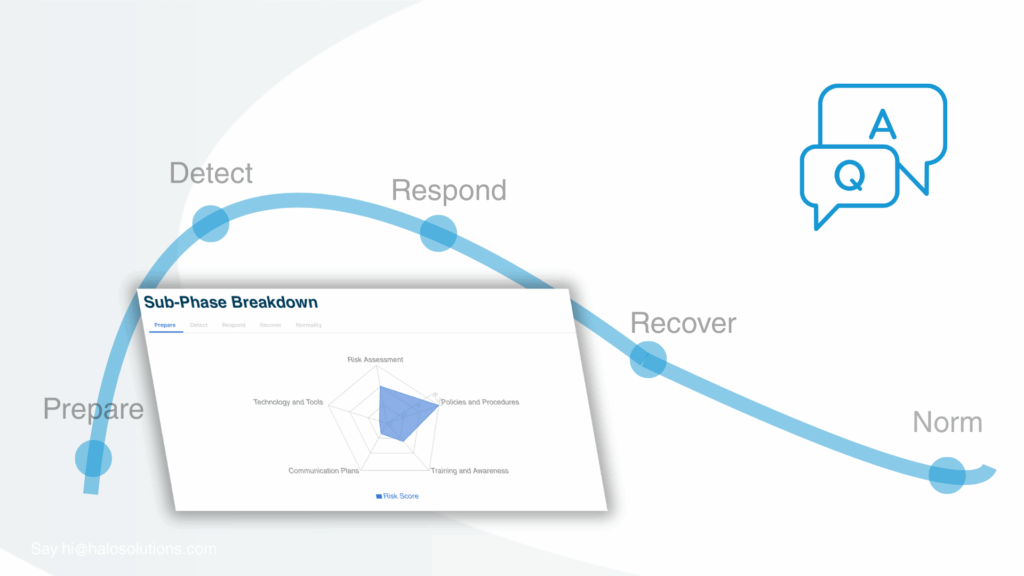
The Incident Response Curve (IRC) is a powerful framework that visualises how teams react during the lifecycle of an incident, from recognition through to resolution. Developed by Trevor of Metier Solution, a seasoned professional with over 20 years of experience in defence, cyber and security innovation. The IRC reveals insights about response patterns and identifies opportunities to enhance preparedness and resilience.
The 4 Phases of Incident Response
- Detection: This is the moment when an incident occurs or is first identified. The curve starts to rise as the problem grows. Detection may involve monitoring systems, user reports or automated alerts. The speed and accuracy of detecting an incident directly influence the organisation’s ability to contain and manage it.
- Response: After detection, the response phase begins. This involves classifying the severity of the incident, containing its effects and taking steps to stop its escalation (such as isolating affected systems or shutting down compromised areas). The goal here is to minimise the damage and prevent further spread. In this phase, the curve continues rising, representing the growing impact but effective response can slow the rise.
- Recovery: Once the incident is contained, the focus shifts to recovery—restoring services, recovering data and returning to normal operations. The curve begins to descend as the impact lessens. The speed of recovery depends on factors like the severity of the incident and the readiness of backup systems. Effective recovery strategies bring operations back to normal more quickly and with fewer long-term effects.
- Return to Normal Operations (Norm): The final stage is when normal operations are restored and the incident is resolved. The curve reaches its baseline again. However, after every incident, a post-incident review should take place. This is the time to learn from the incident, identify any weaknesses in detection, response or recovery processes and implement improvements for future preparedness.
Unlock Your Team’s Incident Response Potential
Optimise your event safety and security strategy with our free IRC Calculator.
Using a short, interactive questionnaire, the IRC Calculator will:
- Help you pinpoint where your operation currently sits on the Incident Response Curve
- Reveal key strengths and vulnerabilities in your incident response approach
- Provide tailored, actionable recommendations to boost your capability and help you save time, money and lives
- Support business case development and expenditure justification
At the end of the process, you’ll receive a personalised results summary.
Stay ahead of the curve. Get started now.
Halo Solutions is proud to announce a new partnership with industry veteran Roger Hooker, founder of Hooked On Events, who joins Halo as Advisor & Ambassador. With more than 30 years of international event experience, Roger brings deep operational knowledge and leadership to help shape the future of Halo and its customers.
Bringing People and Technology Together
Halo was founded by practitioners who know the reality of live operations; where safety, service, and decision-making are always under pressure. That same philosophy underpins Roger’s new consultancy, Hooked On Events, which specialises in bringing clarity and calm to complex event environments.
Roger’s career has taken him from London 2012 and Ascot Racecourse, to global roles including Operations Director for the ABB FIA Formula E World Championship, and most recently, Venue COO at ExCeL London. In every role, his reputation has been built on uniting teams, creating clarity under pressure, and delivering world-class events.
This ethos aligns perfectly with Halo’s mission: giving organisations the tools, systems, and support they need to protect people, safeguard venues, and deliver seamless operations.
A Valued Partnership
This partnership brings lasting value to both organisations, with Roger’s involvement playing an important role in shaping Halo’s future. As an advisor, Roger’s decades of experience will provide a valuable industry voice within Halo’s technology roadmap. The Halo System has always been developed in close collaboration with customers and industry experts, ensuring Halo’s new features and innovations anticipate and respond to emerging industry and needs and standards. Roger’s insight will strengthen this approach, helping Halo to keep creating solutions that are not only relevant today but prepared for the challenges of tomorrow.
With shared values and commitment to the safety industry, together, Halo Solutions and Hooked On Events will highlight the importance of operational excellence and shine a light on the individuals who work tirelessly behind the scenes to deliver safe, successful events. By combining technology, lived operational expertise, and a shared drive to elevate industry standards, the partnership ensures that Halo continues to deliver trusted, expert-backed solutions to its growing community of customers.
“Exceptional things don’t happen, without exceptional people conceiving of and then delivering them. Roger exemplifies the very best of us in the global events industry having been part of the conception and delivery of some of the most prestigious and biggest event brands and locations worldwide throughout his illustrious career. To be able to partner with him in bringing our message to the World marks the beginning of a truly exciting next chapter in our scale-up journey.”
– Lloyd Major, Founder & CEO of Halo Solutions
A Shared Philosophy
Halo has always believed in putting people first—through transparent pricing, customer-led product development, and long-term relationships built on trust. Roger’s approach through Hooked On Events mirrors that philosophy: independent, pragmatic, and focused on bringing people together to deliver ‘brilliant’.
“Our absolute primary responsibility is to keep people safe within our care. This is Halo’s DNA – with collaboration and innovation with practitioners to provide the best possible pragmatic tools. I’m hugely excited to be working with this energetic business that has challenged the market norms, grabbed interest globally, and to further bring together world class technology to those with lived operational experience.”
– Roger Hooker, Founder of Hooked on Events
Together, Halo Solutions and Roger Hooker will give clients the best of both worlds; cutting-edge technology backed by lived expertise in delivering world-class events.
Discover The Halo System incident management software. Explore Hooked On Events services
Imagine stepping onto a plane and learning there’s no black box onboard. Would you stay on? In the aviation industry the black box is non-negotiable. It records everything: the conversations, the data, the timings, the decisions (good and bad), and it’s your only chance of learning from a crisis if something goes sideways.
Now ask yourself: how is your venue different?
You’ve got teams working hard, visitors relying on you, compliance obligations to meet, and a brand to protect. But if something serious happened tomorrow, could you quickly find out exactly what was said, what was done, who made which decision and when?
For many venues, the answer is… not really.
This is where The Black Box Mandate comes in.
What is The Black Box Mandate?
It’s simple. It’s the idea that every organisation, venue, event, or business needs a system that captures, stores, and protects the critical data behind your decisions, communications, timings, and action, just like aviation does.
The difference? In aviation, it’s compulsory. In the public safety world, it’s still a luxury.
Until now.
We’re calling time on that. In a world of rising risk, increased scrutiny, and the looming weight of legislation like the Terrorism Protection of Premises Act, a venue version of a black box isn’t a “nice-to-have” anymore. It’s a moral, and operational must-have.
Many venues don’t realise they’re missing it
That’s not a criticism – it’s just the reality. Most venues run smoothly day to day, and that’s brilliant. But when the unexpected happens, it’s all too easy to find yourself chasing scraps of information: spreadsheets, screenshots, email chains, WhatsApp threads, video clips… and gut instinct.
By then, the opportunity to get the facts straight is slipping away.
“When something goes wrong, people don’t want opinions. They want evidence.”
Lloyd Major, Founder & CEO of Halo Solutions
That’s where The Halo System comes in – your single source of truth. A clear, searchable, time-stamped, protected record of your operations in real time. All reported, managed and recorded via the very best cloud-based IMS. No tampering, a full and complete audit trail that meets evidentiary standards. So, when anyone asks, “What happened?” you’ll already have the answer.
Not just for disasters, either.
Your black box isn’t just for catastrophes. It’s also your guardian angel for:
- Insurance claims (less he-said-she-said, more here’s-what-actually-happened)
- Legal disputes (the evidence doesn’t lie)
- Staff handovers (no more “Dave’s off sick and took the plan with him”)
- Post-event reviews (intelligence powered by insight)
- Compliance audits (hello, TPoP)
And if you do face a major incident, it becomes your most valuable asset. Not just for accountability but for learning, improving, and protecting your team, your brand, and your future.
This isn’t surveillance. It’s smart stewardship.
Let’s address the elephant in the server room: “Isn’t this a bit… intense?”
This isn’t about surveiling your teams’ work or micromanaging. This is stewardship. You don’t need to watch everything; you just need to make sure that when key moments happen, they’re recorded, reviewed, and remembered.
It’s about giving your team easy access to clarity. Confidence. A shared understanding of what’s happening and how to respond, and how to carry these findings into the future.
Don’t be left behind
We call it The Black Box Mandate because it’s fast becoming more than a best practice. As expectations grow and standards rise, having a cloud-based IMS in place isn’t just smart, it’s futureproof.
Halo is the black box for your business.
Your always-on, always-recording, always-available safety and security operations record.
There to make your business safer, smarter, and more defensible.
You wouldn’t fly without one, so why operate without one?
The Black Box Mandate is here. Get ahead of the curve and see what impact this could have on your venue, with our free Incident Readiness Calculator.
Read more about the Black Box Mandate in our industry report: Public Safety in Numbers
In today’s fast-moving threat landscape, venue and event security teams need more than just good instincts, they need proven, repeatable frameworks that work under pressure. That’s why we created the Integrated Threat Management Aide Memoire: A quick-reference tool for security professionals, designed to help you and your team make fast, informed decisions in critical situations.
Whether you print it, keep it on your device, or integrate it into your team briefings, this tool can help you respond smarter, act faster, and safeguard more effectively.
In this article, we’ll break down the 7 core frameworks in the Aide Memoire and show how they can strengthen your integrated threat management approach.
Download your free copy of the Aide Memoire, with these frameworks and more, here.
Joint Decision Model
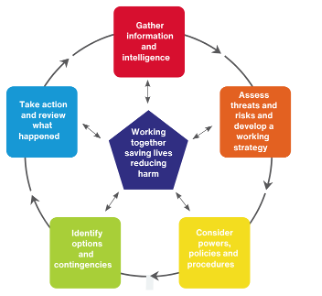
When time is critical, clarity is everything. The Joint Decision Model helps you coordinate effectively with partner agencies, assess risks, and decide on the most appropriate action.
It focuses on:
- Gathering information and intelligence
- Assessing threats and risks
- Considering powers, policies, and procedures
- Identifying options and contingencies
- Taking action and reviewing the outcome
Used correctly, the JDM ensures that everyone in the chain of command is aligned and informed.
HOT Protocol – Unattended item assessment
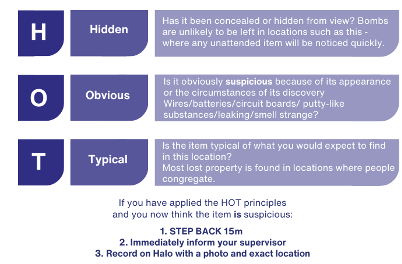
When you find an unattended item, your ability to quickly determine if it’s lost property or a suspicious device can save lives.
HOT stands for:
- Hidden – Has it been concealed or hidden from view?
- Obviously Suspicious – Wires, batteries, substances, unusual smells?
- Typical – Is it what you’d expect to find in that location?
If the item fails the HOT test, you step back, inform, and record — following your cordon and communication procedures.
Four Cs & 5 Ws – Information to prepare for Police
This dual framework ensures you control the scene and communicate the right details to police and emergency responders.
The Four Cs: Clear, Control, Confirm, Communicate.
The Five Ws: What, Who, Why, When, Where.
The result? A scene that’s secure, documented, and ready for professional assessment.
METHANE – Shared situational awareness
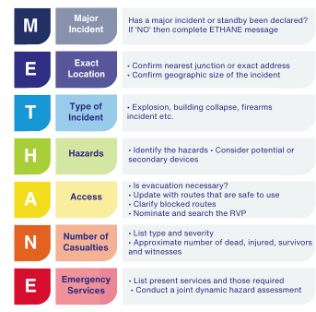
Used widely across UK emergency services, METHANE ensures everyone has a consistent operational picture. It’s an interoperability essential that reduces confusion in multi-agency incidents.
Crowd Tension Indicator
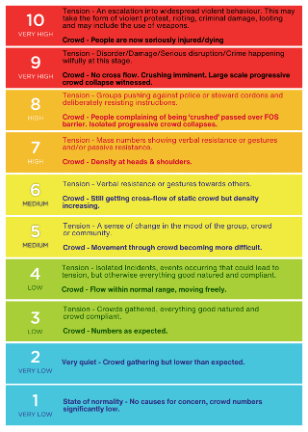
Crowds can shift from compliant to hostile in moments. By tracking indicators like crowd density, mood changes, and signs of agitation, you can spot early warning signs before escalation.
These cues help you adapt stewarding, adjust communications, and, if necessary, coordinate rapid intervention.
Threat Assessment – Identify, Intent, Capability, Immediacy
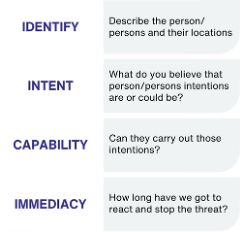
A simple but powerful threat model, this method keeps your threat analysis fast, structured, and actionable.
CBRN Approach – Casualty hazard awareness
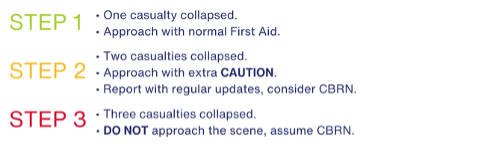
Chemical, Biological, Radiological, and Nuclear threats require special caution. This step-based approach helps you decide how close you can get to casualties safely.
Why These Frameworks Matter
Integrated threat management is about reducing decision fatigue under stress. With a shared set of tools and language, your team can:
- React faster
- Avoid mistakes
- Improve coordination
- Save lives
The Aide Memoire brings all these frameworks into one portable reference, so you’re never more than a glance away from critical guidance.