What Modern Campus Security Systems Need To Deliver In 2026
Quick Links
The campus security landscape has fundamentally changed
Across the higher education sector, expectations around campus safety have shifted — not dramatically, but meaningfully.
Universities are operating in increasingly complex environments, where open access, high footfall, and multiple stakeholder groups intersect with growing scrutiny around safeguarding, protest management, and duty of care. Recent coverage from BBC News reflects this broader context, but for most campus security teams, it’s simply an extension of what they’re already managing day-to-day.
What has changed more noticeably is the expectation around how incidents are handled — and, importantly, how clearly those actions can be understood and evidenced afterwards.
At the same time, many of the systems supporting campus operations have evolved more slowly. It’s still common to see information spread across multiple tools, with teams relying on a combination of formal systems and informal communication channels to manage incidents and day-to-day activity.
As a result, the conversation is beginning to move away from what tools are in place, and towards a more practical question:
What should a modern campus security system actually deliver in a university environment today?
What are the core requirements of modern campus security systems?
A university campus presents a uniquely demanding operational environment, combining open public access, high-density populations, and a wide range of incident types — from routine welfare concerns through to complex, multi-agency responses.
Within that context, the effectiveness of a campus security system is defined less by individual features, and more by how well it supports coordination, visibility, and accountability while reducing unnecessary operational overhead.
In practice, several requirements are becoming increasingly difficult for universities to operate without:
key features of university security systems
1. A single source of truth for campus security operations
Incidents, actions, and communications need to sit within one consistent operational record. When information is spread across multiple tools, teams end up duplicating effort or piecing together updates. A centralised approach reduces that friction and keeps decisions aligned.
2. Built-in multi-agency coordination across university teams and partners
Campus incidents rarely sit within one function. Security, estates, welfare teams, contractors, and external services all need to coordinate effectively. Systems should enable a shared, real-time operational picture, rather than relying on manual handovers.
3. Real-time visibility across campus safety and day-to-day operations
Security leaders need visibility as situations unfold — not just after the fact. This supports more proportionate responses, better prioritisation, and less reliance on delayed or incomplete information.
4. Audit-ready reporting and compliance for university security environments
Clear, time-stamped records of actions, decisions, and involvement are now essential. Fragmented or manual processes make this harder to achieve, even when responses themselves are appropriate.
5. Support for day-to-day operational activity to drive consistent usage
Systems need to support routine tasks and workflows, not just major incidents. Consistent day-to-day use is what ultimately drives adoption and reliability when it matters.
6. Accessible public reporting for students, staff and visitors
Universities need a simple way for people to report incidents or concerns without friction. Requiring logins or complex processes can discourage reporting altogether. Providing secure, accessible options for self-reporting helps capture more accurate information, earlier — and supports a more proactive approach to campus safety.
Why fragmented campus security systems create operational risk
In many universities, the challenge is not a lack of capability, but a lack of connection between systems.
Incidents may be logged in one platform, communicated through another, and formally reported elsewhere. While this can function day-to-day, it often requires teams to manually transfer information, duplicate updates, or rely on informal channels to keep everyone aligned.
Over time, this creates a fragmented operational picture.
The impact is rarely a single point of failure, but rather a gradual accumulation of small inefficiencies — delays in communication, inconsistencies in records, and additional administrative burden. In environments where multiple teams are required to coordinate quickly, these inefficiencies can make it harder to maintain clarity and confidence during live situations.
This also has implications beyond the incident itself. When information is distributed across systems, reconstructing events afterwards can become time-consuming and, in some cases, incomplete.
How universities can improve campus safety, coordination and visibility
Improving campus safety systems is rarely about introducing more tools. In most cases, it involves simplifying and better connecting what already exists.
For many universities, this means moving towards a more unified operational approach — one where incidents, actions, communications, and reporting are brought together, rather than managed separately across different platforms.
Importantly, this does not always mean replacing existing systems entirely. In many cases, universities already have established tools for specific functions, such as emergency communications or access control. The opportunity often lies in reducing duplication and creating clearer links between systems, so that information flows more naturally across teams.
The benefit of this approach is not just efficiency, but reduced operational overhead. When teams are no longer required to manually reconcile information or manage multiple disconnected workflows, it becomes easier to maintain consistency, respond effectively, and evidence actions when required.
This is a direction already seen across other safety-critical sectors, where the combination of regulatory pressure and operational complexity has driven a move towards more integrated systems. Higher education is increasingly encountering similar conditions, albeit within a uniquely open and dynamic environment.
A more joined-up approach to university security systems
At Halo, we’ve built our platform around the realities of high-pressure, multi-agency environments — where coordination, clarity, and accountability are essential, but so is ease of use.
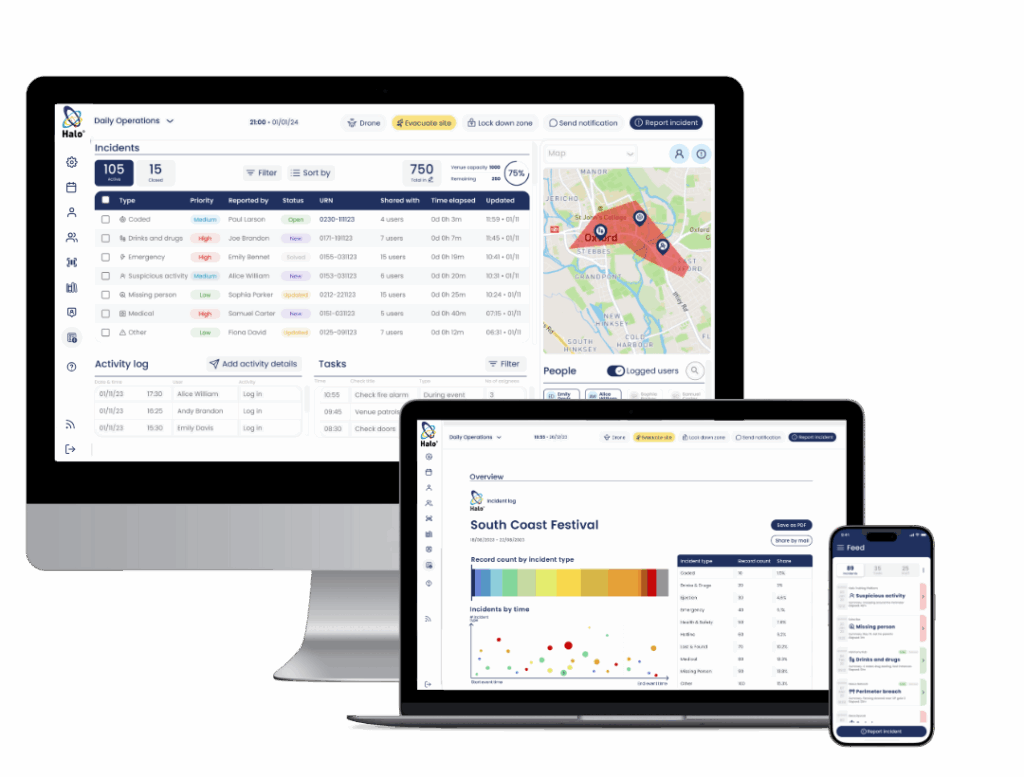
The Halo System brings together incident management, tasking, real-time coordination, and audit-ready reporting into a single operational platform, designed to support teams both during incidents and as part of day-to-day campus activity.
For universities reviewing their current approach, the focus is often less on adding new tools, and more on understanding how existing processes can be simplified, connected, and made easier for teams to manage in practice.
If you’re currently exploring this, you can learn more here:
👉 Halo for Universities
👉 How Halo is helping Birmingham City University save 25-30 hours a week
Or, if you’re attending any AUCSO conferences or roundtables this year, come and speak to the team — we’re always keen to share insights from across the sector and hear how others are approaching similar challenges.
Ready to try it for yourself?
Discover how Halo can help you connect your campus safety & security operations.